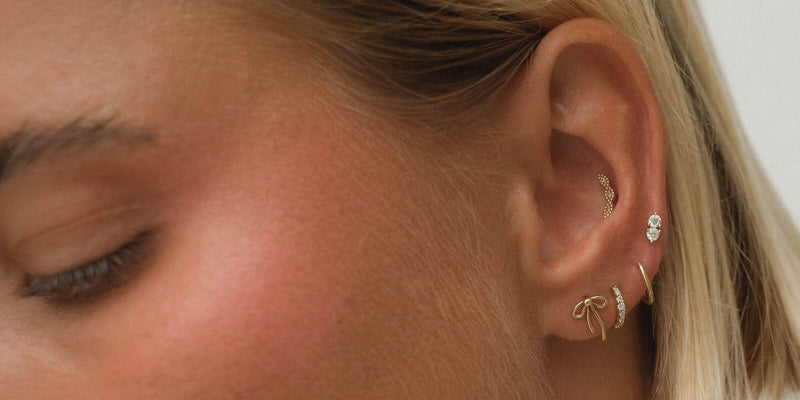
Helix piercing guide: what to wear and how to size it


How to choose jewelry for your helix, find your size and know when it's time for the hoop you've been saving for.
A helix piercing sits along the upper outer rim of your ear. One tiny diamond, a close-fitting hoop, a double helix you've been planning for years. There are so many ways to wear it. But before you get to the fun part, you need the right fit.
I have 18 ear piercings, including a double helix, and I design earrings for the way I actually wear them: all day, all night. What I've learned is that the shape of the earring matters just as much as the size of the post.
This is my guide to choosing jewelry for your helix, finding your size and knowing what to save for once it's healed.
Helix fast facts
- Placement: cartilage along the upper outer rim of your ear. A forward helix sits at the front of the rim, near your face.
- Gauge: 18G is approximately 1.0 mm; 16G is approximately 1.2 mm. Ask your piercer which suits your placement.
- Starting jewelry: my preference is a smooth flat back stud, with enough post length for swelling, fitted by your piercer.
- Healed post length: 5 mm to 6.5 mm. New or still-healing: 8 mm, to allow for swelling.
- Hoop size: check the inner diameter and wire thickness. Placement, angle and the distance to the rim all matter.
- Materials: appropriately made solid 14k or 18k gold, or implant-grade titanium such as ASTM F136.
- Jewelry changes: your piercer may downsize the post during healing. Switching to a hoop comes later.
Where your helix sits changes the fit
An upper helix sits toward the top of your ear. A mid or low helix sits farther down the outer rim. A forward helix sits at the front, just above where your ear meets your face, in a smaller space that often suits smaller earrings.
A double or triple helix means two or three separate piercings. Each one needs its own fit. Don't assume that because two piercings sit next to each other, they need the same post length or hoop diameter.
Three things make the difference: the thickness of your ear at that spot, how far the piercing sits from the edge, and the angle of the piercing. A hoop needs to clear the rim without pulling. A post needs enough room without leaving unnecessary length to catch and move around.
A snug piercing sits on the inner cartilage ridge. It's a different placement, so don't use helix sizing advice for it.
Before you're pierced: start with the fit
Ask about gauge
I personally prefer 18G. It's what I wear, and I find the thinner post feels more comfortable in my piercing, with less pressure. That doesn't mean thinner is better for every ear. Ask your piercer what suits your anatomy and placement.
Many piercers use 16G for a helix. Talk about the jewelry you'd eventually like to wear before you're pierced, so you understand how its gauge and shape will work with the placement.
Let your piercer fit the first post
A fresh helix needs room for swelling. Our size guide recommends 8 mm for a new or still-healing helix, to allow room for swelling. Your piercer will confirm the length for your anatomy.
As swelling settles, they may recommend a shorter post before the piercing is fully healed. That's downsizing. A long post can start catching and moving around once you no longer need the extra space. A short post can squeeze. Neither is the goal.
Have your piercer handle changes while it's healing.
Choose the material as carefully as the design
You can be pierced in solid gold. Suitable solid 14k or 18k gold needs to be nickel- and cadmium-free, alloyed for biocompatibility, and properly finished. Implant-grade titanium, such as ASTM F136, is another option.
The exact piece matters too: a smooth surface, a suitable shape, the right gauge and length, and appropriate sterilization. A “14k gold” label alone doesn't tell you all of that.
Save the hoop for later
I know. The tiny hoop is probably why you booked the appointment.
My advice is to start with a well-fitted flat back and save the hoop for later. Hoops can move and catch, and a hoop that's too small can pull on your piercing. Let your piercer confirm when your helix is ready for the switch.
Looking calm on the outside isn't the same as being fully healed inside. The hoop can wait.
Which earring to wear once it's healed
The flat back stud
The simplest place to start. A flat back has two parts: the post with its flat back attached, and the decorative front. On our internally threaded flat backs, the front screws into the post.
The right fit brings the front close to your ear without squeezing it. And behind your ear, you have a smooth back rather than a pointed post sticking out.
Our flat back earrings guide walks through the measurements and how to put them in.
The hoop look on a straight post
This is my favorite helix trick, and what I wear.
Patt and Fat Patt have a front that curves around the edge of your ear, with a straight post and flat back through the piercing. You get the hoop look from the front, with flat back construction behind it.

When the fit is right, that cupping shape helps limit the back-and-forth movement. It should sit lightly around the rim, not clamp onto it. The shape still needs to suit your ear, and the post still needs to fit.
The U hoop
A compact U shape that wraps around the edge of your ear, with a decorative front that screws on.
A 5 mm inner diameter is one size I like for a close-fitting helix. A 7 mm option may suit a piercing farther from the rim or a look where the front sits a little lower. Neither is a size every helix should wear.
Check the wire thickness as well as the inner diameter on your chosen product. If it's thicker than the jewelry you currently wear, ask your piercer to check the fit. A taper is a guide, not a reason to push thicker jewelry through.
The clicker hoop
A ring with a hinged section that clicks shut. This is the classic hoop silhouette.
The fit depends on your placement and how much space the ring needs to clear your ear. The same 5 mm hoop can fit two ears very differently. Check the gauge and inner diameter of the specific design, rather than choosing by the photo alone.
How to find your size
A flat back needs two measurements: gauge and wearable post length. A hoop needs its wire thickness and inner diameter.
Gauge
The smaller the gauge number, the thicker the jewelry. An 18G post is approximately 1.0 mm; a 16G post is approximately 1.2 mm.
Check the Size & fit details on the earring you're buying. Don't force a thicker post through a smaller piercing. If you switch to thinner jewelry, the piercing may settle around that size over time, so discuss it with your piercer if you plan to switch back later.
Post length
Measure the wearable bar between the inside of the flat back and the base of the decorative front. Don't include either end.
For a healed helix, 5 mm and 6.5 mm are examples you may see in our range. Some ears need a different length. Close-fitting doesn't mean tight: neither end should dig into your ear.

Size recommendations are a guide only. Fit depends on your piercing placement, healing stage, aesthetic preference and ear anatomy (e.g. lobe and cartilage thickness). Contact customercare@adornmonde.com for assistance or consult your local piercer.
If a settled helix becomes swollen or the post starts pressing, have the fit checked rather than assuming you need to squeeze it back into the same jewelry.
Hoop diameter
Measure across the inside of the ring. Outside width and diamond size are different measurements.
The hoop needs to clear your rim without pulling, pressing or changing the angle of your piercing. Your piercer can help measure this, especially for a forward helix or a piercing that sits farther into the ear.
Write it down
Once you've found your fit, save the gauge, post length or hoop diameter, and placement in your phone.
“Upper helix: 6.5 mm; lower helix: 5 mm” is much more useful than “I think I wear small.” Those are example measurements, not a prescription for your double helix.
What your helix earrings should be made of
For the solid 14k gold flat backs in our piercing range, the gold isn't a surface coating over a different base metal. That's the difference between solid gold and gold-plated jewelry.
For a fresh piercing, gold-plated, gold-filled and vermeil jewelry aren't suitable choices. Ask your piercer to confirm that the exact piece meets the material, finish and construction requirements for initial jewelry.
If titanium is your choice, look for a specified implant-grade material rather than relying on a vague label. The same applies to “surgical steel”: the name alone doesn't tell you the grade.
And if your ears react to particular metals, check the alloy. Solid gold doesn't guarantee that every ear will tolerate every piece. Our guide to earrings for sensitive ears explains what to look for.
Changing your helix earring
These steps are for a fully healed piercing and an internally threaded flat back. Your piercer should handle jewelry changes during healing.
- Wash and dry your hands. Start with clean jewelry and a clean, compatible taper, and check how the earring fastens before removing it.
- Gently pass the taper through your healed piercing from the front.
- Behind your ear, fit the taper tip into the open end of the flat back post.
- Keep them connected and guide the post through as the taper comes out at the front.
- Remove the taper, hold the flat back steady, and screw on the decorative front until snug.
Right is tight. Left is loose. Just remember you're looking at the front of the earring.
If the jewelry or taper meets resistance, stop. Don't force it. And if the front won't screw in smoothly, back it off and line it up again.
Our 2-piece taper set includes straight and curved guides. Choose the compatible tool and shape that give you the easiest access to your placement. The Lazy Girl Jewelry® Kit brings the little helpers together, and our flat back earrings guide covers the full process.
A threaded front can loosen with wear, so check it regularly with clean hands. Ask your piercer to show you how to check the fastening without rotating the post through a healing piercing.
Sleeping on a helix
I'm a side sleeper, so this matters to me.
Once your helix is healed, the right post length and a smooth, well-fitted front can make sleeping much more comfortable. But a flat back isn't a promise that every earring will feel good against your pillow. A large or pointed front can still press, and an earring that squeezes your ear needs its fit checked.
While it's healing, keep pressure off it. A piercing pillow can help you rest with your ear in the opening rather than pressed against the pillow.
Don't use sleeping on it as a test of whether it's healed. If it hurts, don't push through it.
Looking after it
You still need to clean it. Obviously.
While it's healing, follow your piercer's aftercare instructions. Sterile saline wound wash is the straightforward option. Don't twist the jewelry, pick at it or keep taking it out to check it. Keep hair products away and avoid pressure and catching.
If it's becoming increasingly painful, hot or swollen, or you suspect an infection, get medical advice. Don't assume a new earring will fix it.
Styling your helix
One small diamond high on the rim can be enough. A curved flat back can give you the hoop look. A double helix can repeat a shape or step down in scale.

I like a little breathing room between placements. Every earring should earn its place, and your helix doesn't have to compete with everything happening in your lobe.
Once you've found your fit, this is the fun part. Our Ear Architect styling guides help you work out how your helix connects with the rest of your stack.
The
FAQs
What earrings can I wear in a helix?
Once it's healed, options include a flat back stud, a curved-front flat back, a U hoop or a clicker. Choose the gauge, size and shape for your placement.
Should I ask for an 18G helix piercing?
You can ask. It's my personal preference, but your piercer needs to confirm the gauge that suits your ear and placement.
What size post do I need?
As a guide, a healed helix starts at 5 mm to 6.5 mm, and a new or still-healing one takes 8 mm. Your piercer can measure the fit.
When can I change to a hoop?
Once your helix is fully healed and your piercer has confirmed the hoop is suitable. Downsizing a post during healing is a separate change, handled by your piercer.
Can I sleep on my helix?
Avoid pressure while it's healing. Once healed, comfort depends on your ear, the post length and the front's size and shape. A flat back doesn't make every design comfortable to sleep on.
Is solid 14k gold suitable for a new helix?
It can be, provided the exact piece is nickel- and cadmium-free, alloyed for biocompatibility, properly finished, appropriately sterilized and fitted for your piercing. Ask your piercer to confirm the piece.
What's the difference between a helix and a forward helix?
A helix sits along the outer rim toward the top and back of your ear. A forward helix sits at the front of the rim, near your face. It often has less room for jewelry, so don't assume the same sizes will fit both.